Evidence, not assertions.
Most organisations can list their AI tools. Far fewer can show who owns each one, which obligations apply, what evidence exists, and who checked it. Eshalu runs one governed engagement and assesses every AI system separately — and an authorised human reviewer decides what each result means.
Adoption has outrun the proof
A policy document is not evidence. Boards, buyers and regulators ask what is actually true — and a one-off assessment goes stale within a quarter, because models, suppliers and rules keep moving.
AI arrives from everywhere
Many teams, many vendors, and capability embedded inside products that were bought for something else.
Assertion is not assurance
Someone has to be able to show the evidence behind each claim, and say who checked it and when.
The picture moves
A model version, a supplier or a rule changes, and an assessment that was true stops being true — quietly.
One governed engagement. A separate record for every AI system.
Organisation-wide governance is assessed once. Each AI system is then assessed on its own path, according to its use case, impact, autonomy, data and regulatory signals — so a low-risk assistant is never assessed like a decision system.
AI system register
Purpose, owner, vendor, lifecycle, risk band, regulatory signal and control position for every system.
Control results
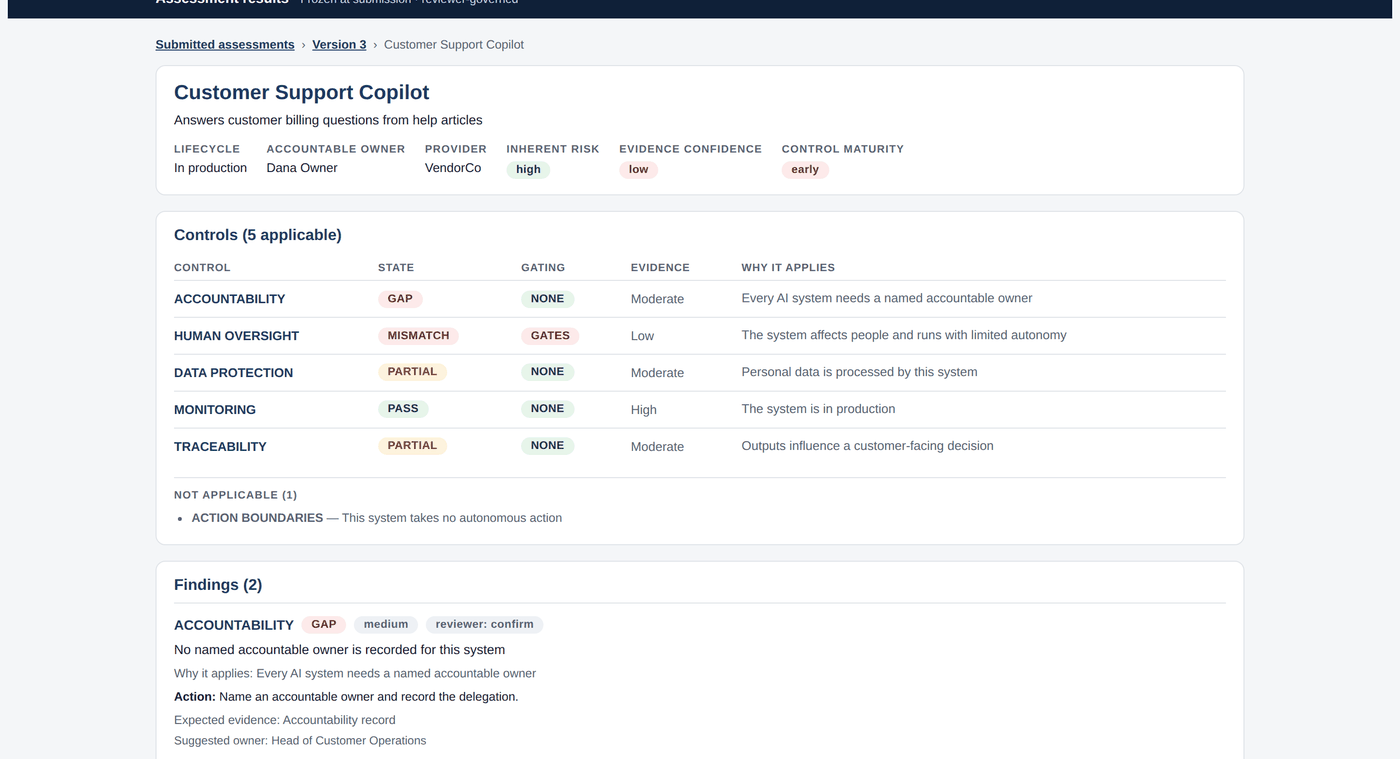
Every control, its state, and the recorded reason it applied to this system — or did not.
Evidence log
What was requested, provided, accepted, missing or reused, with versions and custody.
Gap and action plan
Findings converted into owned actions with due dates, status and closure evidence.
Readiness view
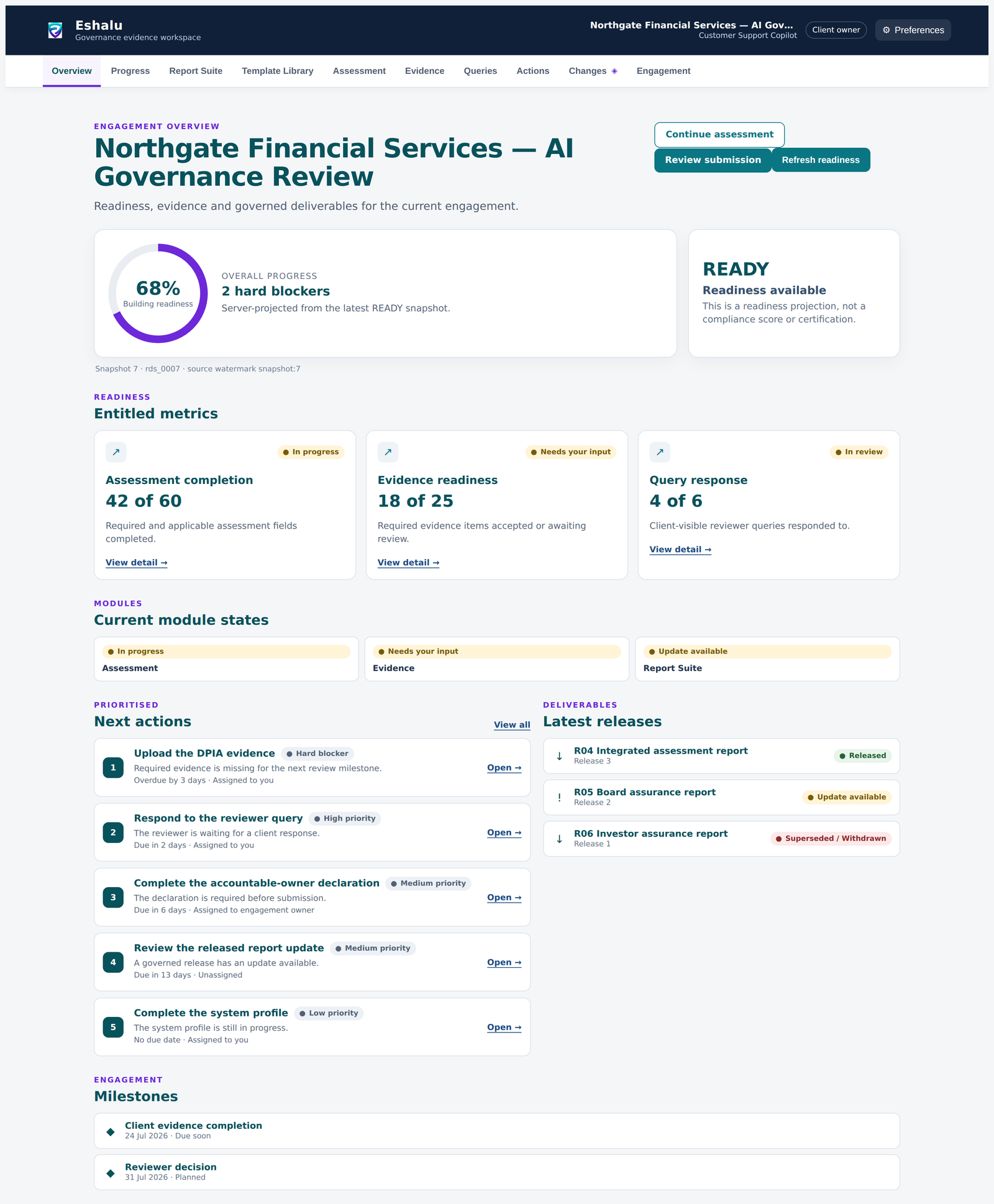
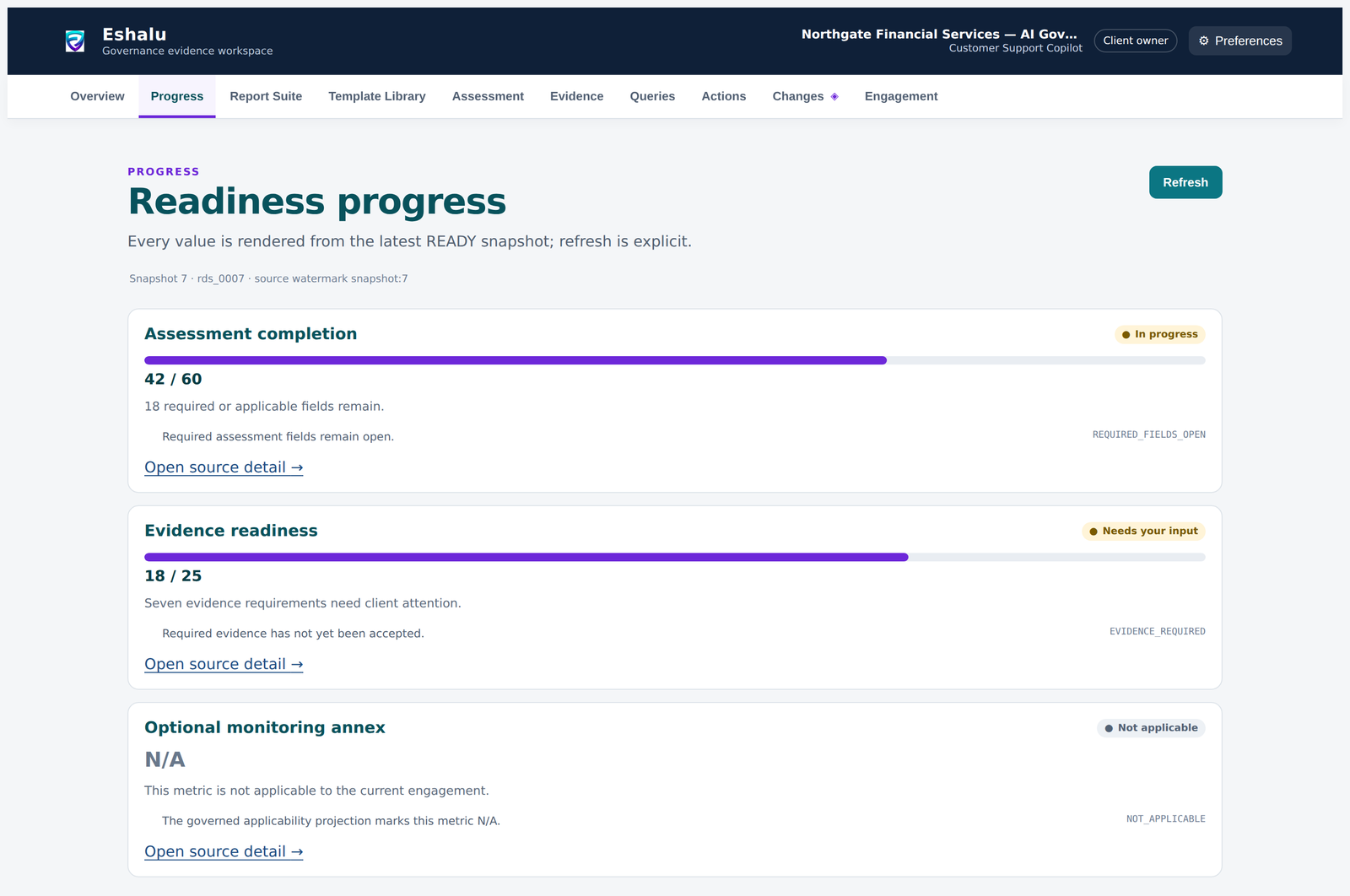
Server-computed progress and blockers. Never a browser-side score, never a compliance grade.
Report suite
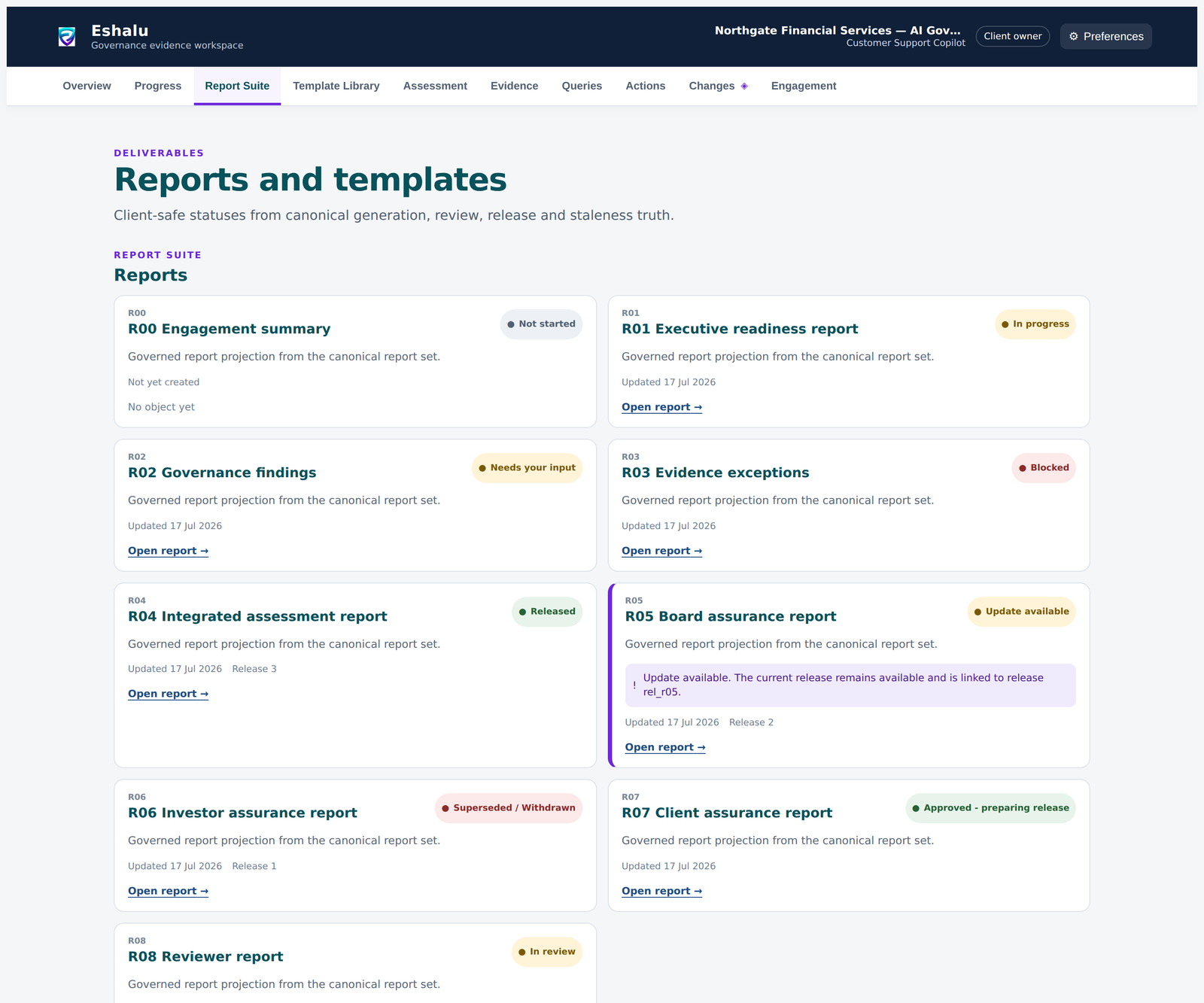
Board, CXO, buyer, investor and detailed outputs — each scoped to what that audience may see.
What the client actually sees
Current release-candidate interface — illustrative data. The product has not completed staging or production release.

Each control shows its state, whether it gates, the evidence confidence behind it, and why it applied — with the reviewer's wording in place of the generated text.
Four engagement models
Priced according to the systems, evidence position and review work required — not by charging separately for every framework mapped.
Focused Assessment
£3,000–£7,500
excluding VAT
One AI system or one priority governance concern.
Portfolio Assurance
£8,000–£20,000
excluding VAT
An agreed portfolio of systems, suppliers, functions or business units.
Remediation and Readiness
£20,000–£40,000
excluding VAT
Convert findings into owned controls and independently reviewed closure evidence.
Continuous Assurance
£25,000 per year
excluding VAT
Maintains an agreed baseline after the initial assessment.
Material new systems, significant drift and major changes are separately scoped.
View engagement models and pricingBuilt by the person who reviews the work
Raghuram Saripalli
Founder & Chief Executive, Eshalu
Most organisations can list their AI tools. Far fewer can show the evidence behind them. Eshalu exists to close that gap with a governed record rather than a document. Raghuram brings 23 years in enterprise systems, architecture, governance and large-scale ERP and business transformation, an AI Law, Policy and Governance certification from the London School of Economics, and is currently completing PECB ISO/IEC 42001 Lead Implementer certification — and leads the methodology, the reviewer standard and every client engagement personally. More about Eshalu →
Start with one system. Scale when it earns it.
Run one focused assessment on a single AI system. You get the register, the control results, the evidence log, the gap and action plan and the report outputs — then decide whether to scale.
See engagements and pricingStart a conversation