AI Governance Assessment & Assurance
Productised, evidence-led assessment of AI systems. We establish what applies, what evidence exists, where the gaps are and what an authorised human reviewer can reasonably conclude.

Independent AI governance assessment, responsible AI consulting and practical training — scoped separately so the role Eshalu plays is always clear.
Discuss your AI systemsView engagement models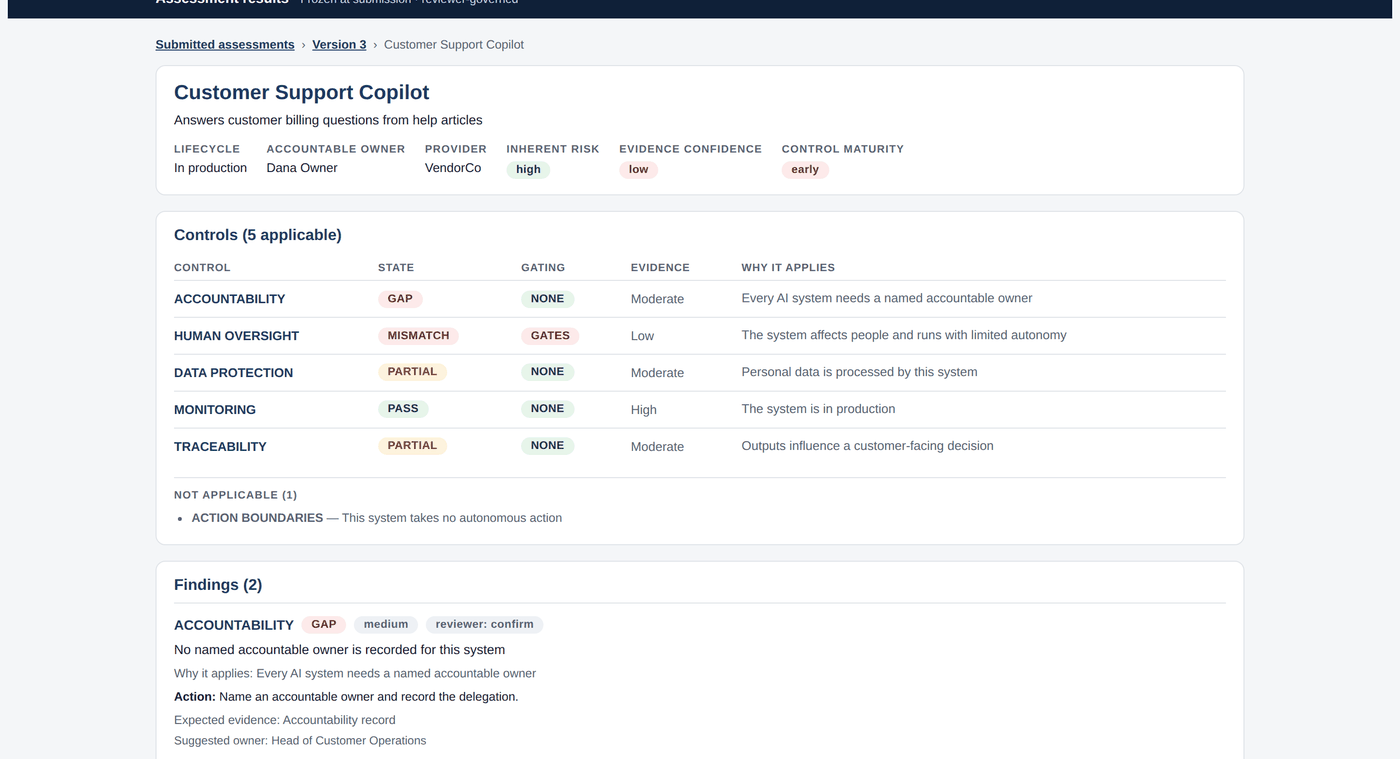
The three service lines can be bought separately. The key rule is simple: Eshalu does not independently assess the same AI system or control work that it has advised on, designed or helped implement.
Productised, evidence-led assessment of AI systems. We establish what applies, what evidence exists, where the gaps are and what an authorised human reviewer can reasonably conclude.
Advice and hands-on support across AI strategy, use cases, value, solution design, testing, governance, data and responsible implementation.
Role-based learning for boards, executives, governance teams, business users, product teams, technical teams and data teams.
Eshalu's productised assessment creates one governed record per AI system and separates organisation-wide governance from the system-specific evidence that supports each conclusion.
Purpose, owner, supplier, lifecycle, autonomy, impact, responsibilities and regulatory signals for the individual AI system.
Governance, accountability, human oversight, security, third-party risk, testing, monitoring, change and operational controls assessed in context.
Evidence around data provenance, permitted use, quality, sufficiency, representativeness, lineage, bias, documentation and ongoing monitoring.
What was requested, supplied, accepted, missing, reused or due for refresh, with version and custody information.
An authorised human reviewer challenges the evidence and confirms what the record does — and does not — support.
Audience-specific outputs, prioritised findings and the evidence or control outcomes required to address each gap. Eshalu may explain the finding without designing the client's solution.
For organisations that want help deciding where AI can create value, shaping the solution and putting the right governance, data and testing foundations around it.
Business objectives, AI ambition, operating model, governance structure, decision rights, roadmap, investment priorities and build-versus-buy choices.
Identify, challenge and prioritise AI use cases; define expected benefits, costs, dependencies, risks, feasibility and measurable success criteria.
Architecture and delivery choices, human oversight, autonomy boundaries, supplier considerations, control-by-design and implementation governance.
Define what good looks like before deployment: evaluation criteria, acceptance thresholds, scenario coverage, safety testing, robustness, human review and post-deployment monitoring.
Data source strategy, provenance and lineage, rights and licensing, permitted use, privacy considerations, collection controls and documentation needed to show where data came from and why it may be used.
Quality, completeness, sufficiency, relevance, timeliness, representativeness, bias and imbalance, training/validation/test separation, synthetic data and monitoring for drift or changing suitability.
Practical, role-based learning rather than generic AI awareness. Training can be delivered as executive briefings, team workshops or tailored capability programmes.
AI opportunities, accountability, investment decisions, governance, risk, regulatory expectations and the questions leaders should be asking.
AI governance operating models, evidence, controls, risk assessment, regulatory concepts, standards and assurance readiness.
Finding useful use cases, defining benefits, responsible adoption, human oversight, supplier use and what good delivery evidence looks like.
Responsible design, testing and evaluation, data provenance and quality, monitoring, change control and evidence that supports governance decisions.
We assess governance and evidence, record gaps and provide human-reviewed conclusions. We can explain required outcomes, but we do not design or implement the controls we later assess.
We can advise on strategy, design, data, testing, governance and implementation. That work is clearly identified as advisory and is excluded from Eshalu independent assessment.
We build capability without taking accountability away from the organisation. The client remains responsible for its decisions, policies, systems and legal advice.